Sports have been one of the most important pillars in my life. They kept me away from the bad and brought me closer to the good. They taught me discipline, focus, resilience, humility, and the beauty of effort. Looking back, I now understand that sports are experiential learning in its purest form.
In the IB we talk a lot about agency, Approaches to Learning (ATLs), the Learner Profile, and developing a mindset that embraces challenge. Many people think these can only be learned in the classroom, inside a structured unit or within a planned inquiry cycle. But the truth is that I learned most of them through sports, through training, through losing and trying again, through movement and discipline.
Sports as a vehicle for human potential
One of my martial arts instructors once told me something I will never forget. I repeat it often, to myself and to my students:
“Martial arts are a vehicle for developing your human potential. Through struggle and difficulty you learn how to be better at everything.”
This is the essence of the Approaches to Learning. Sports develop skills such as:
- emotional regulation under pressure
- problem solving in real time
- creative thinking when the answer is not obvious
- collaboration and positive interdependence
- self-management and personal discipline
- strategy, anticipation, and adaptability
Martial arts are not about violence. They are about strategic thinking, control, respect, and self-improvement. Many people describe Brazilian Jiu-Jitsu as a form of human chess, because it trains your mind to stay calm, think clearly, and create solutions even under stress.
Sports are not just competition
A coach once told me:
“Sports are not only about competition. They are about sharing, supporting others, and being a teammate. But when the clock starts, you have rivals, and that is something you also have to learn.”
That balance between collaboration and competition is deeply connected to the IB philosophy. We learn together, grow together, support each other, and at the same time face challenges that strengthen who we are.
Nothing teaches this better than sports.
Why no child should leave school without practicing a sport
Because sports teach what theory alone cannot:
- how to learn how to learn
- how improvement comes from effort
- how to tolerate frustration
- how to persevere
- how to understand yourself
- how to respect others
- how to lead and follow
- how to stay balanced
In IB terms, sports are a direct pathway to developing attributes of the Learner Profile. Caring, Balanced, Principled, Communicator, Risk-Taker, Reflective, Thinker, Open-Minded. All of them live inside every session, every match, every training.
Sports as a metaphor for the PYP
Sports taught me something that today shapes my practice as a PYP educator. Students need real, meaningful experiences that connect with their identity and passions.
That is why I bring movement, play, real data, and challenges into my classroom. Agency is not taught. Agency is lived.And sports are one of the most human and accessible ways to experience it.
A necessary thank you
To all the coaches I had in different sports: thank you. To the ones who taught beyond technique, who educated through values, who shaped character and not only performance.
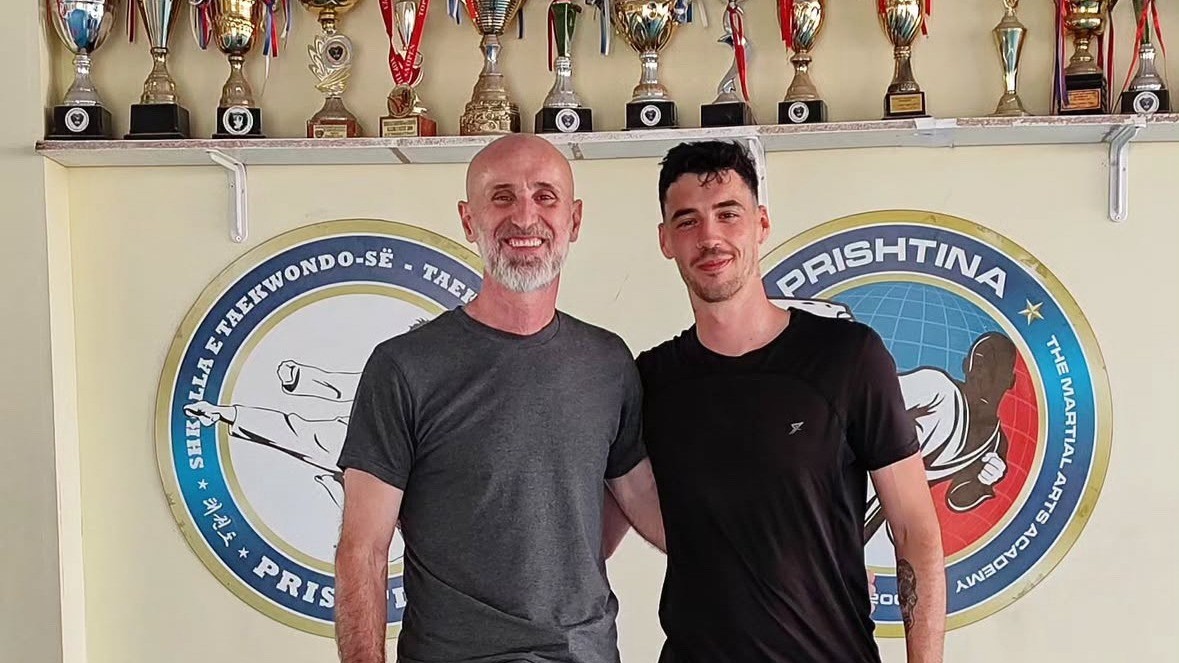
And especially to my friend Nuhi Gashi, with whom I trained taekwondo, grappling, and MMA in Kosovo for four years. Thank you for giving me so much of the good and helping me stay away from what I did not need.
Much of what I believe as an educator was learned sweating on a mat, running on a field, or solving problems inside a dojo.